Why Your Phone Is the First Thing You Reach for When Life Gets Weird
Somewhere between the invention of the television remote and the introduction of infinite scroll, entertainment quietly changed jobs. It used to be leisure — something you did when the work was done, the kids were in bed, and you had a deliberate hour to fill. Now it's something else entirely. It's a reflex. A default state. The thing you reach for not because you want to watch something, but because you need to not be alone with your thoughts for thirty seconds.
Everything, everywhere, all the time — that's not just a streaming slogan. It's a description of what we've come to expect from entertainment as an emotional tool. And the fact that it's available at 3AM, during a panic attack, in a waiting room, or in the thirty uncomfortable seconds before a work meeting starts? That's not a coincidence. That's the whole product.
The Moment Entertainment Became Emotional First Aid
There's a specific feeling most of us recognize but rarely name. It's not boredom exactly, and it's not anxiety exactly — it's somewhere in between. That low-grade restlessness that shows up when you're waiting for test results, when a conversation with a family member goes sideways, when you lie down to sleep and your brain refuses to cooperate. For previous generations, this feeling had fewer exits. You might read, or call someone, or just sit with it.
Now, the exit is immediate and it lives in your pocket. Tap, scroll, play. The discomfort doesn't disappear, but it gets a roommate — something loud enough and engaging enough to share the mental space. That's not entertainment doing its old job. That's entertainment doing something closer to what medication does: managing a state rather than resolving it.
Dr. Anna Lembke, a Stanford psychiatrist who has written extensively on dopamine and compulsive behavior, describes this pattern as "self-medicating with digital content" — using the dopamine micro-hits of scrolling and watching to regulate emotional states that feel unmanageable. The language of addiction, she's noted, maps uncomfortably well onto how many people describe their relationship with streaming and social media.
The Comfort of Infinite Choice (That Isn't Really a Choice)
Here's a paradox worth sitting with: we have more entertainment options than any humans in history, and yet most of us watch the same shows repeatedly, scroll the same apps in the same order, and gravitate toward the same genres when we're stressed. The infinite library doesn't actually expand our choices in moments of emotional need — it just makes the familiar stuff feel more available.
This is what behavioral economists call the "paradox of choice" playing out in real time, with a twist. When you're anxious or overwhelmed, the last thing you want is genuine novelty. Novel content requires cognitive investment — you have to track new characters, new worlds, new rules. Comfort content, by contrast, requires almost nothing. You already know what happens. You're not watching to be surprised; you're watching to be held.
That's why The Office has been in Netflix's top ten for what feels like geological ages. It's not because it's the best show ever made. It's because it's the TV equivalent of a weighted blanket — familiar, low-stakes, and incapable of genuinely upsetting you.
Streaming platforms have figured this out and built for it. The autoplay feature doesn't just save you from having to choose. It saves you from the moment of silence between episodes — the moment where your actual feelings might resurface. The next episode starts before you can think. That's not accidental UX. That's architecture.
The 3AM Problem Nobody Wants to Talk About
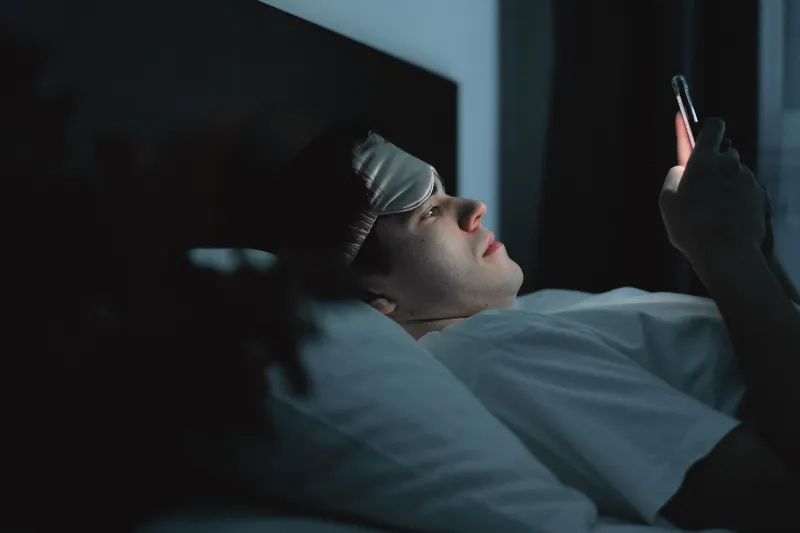
Late-night scrolling has become so normalized that it barely registers as a behavior worth examining. But consider what it actually is: a significant portion of the American population is regularly, deliberately choosing stimulation over sleep because the alternative — lying in the dark with their thoughts — feels worse.
Sleep researchers have documented this pattern under the somewhat clinical term "revenge bedtime procrastination," which describes the tendency to sacrifice sleep in order to reclaim personal time after a day of obligations. But there's a harder version of this that doesn't get as much coverage: the people who aren't staying up to enjoy their free time. They're staying up because putting the phone down means confronting whatever they've been successfully avoiding all day.
The entertainment industry didn't create this problem, but it has profited enormously from it. Every platform that boasts about its "late-night viewing" numbers is, in part, measuring the scale of American sleeplessness and anxiety. Those aren't just engaged users. Some of them are people for whom the alternative to watching one more episode is lying awake in the dark.
The 'Just One More Episode' Lie We Tell Ourselves
The phrase "just one more episode" is one of the most universally understood lies in modern American life. We say it knowing it isn't true. We say it because it isn't true — because committing to "just one more" is a socially acceptable way to commit to an indefinite extension of not dealing with whatever comes after we stop.
What comes after we stop is the point. Sleep, or the attempt at it. The conversation you've been putting off. The decision you need to make. The feeling you've been outrunning since Tuesday. Entertainment, in its role as emotional regulation tool, is at its most powerful not for what it provides but for what it delays.
This isn't a moral judgment. Delaying hard feelings is sometimes exactly the right move — humans have always needed ways to pace themselves through difficult periods. The question worth asking is whether we're pacing ourselves or whether we've lost the ability to stop pacing at all.
What This Actually Says About Modern Life
The shift from entertainment-as-leisure to entertainment-as-coping-mechanism reflects something real about the texture of contemporary American life. Stress levels are measurably high. Loneliness is at historic levels. The structures that used to provide community and meaning — religious institutions, civic organizations, even just neighborhoods where people knew each other — have weakened significantly over the past few decades.
Into that gap, entertainment has moved. Not as a replacement for those things, but as a stop-gap that's always available, never judges you, and doesn't require anything back. It's the perfect companion for an era of exhaustion.
No ratings chart captures this. No streaming metric measures what it means that millions of people are using television as a stand-in for the community and comfort they can't find elsewhere. The "just one more episode" impulse isn't really about the show. It's about not wanting to be alone in the quiet.
The phone is already in your hand. You already know what you're going to do next.
Maybe that's okay. Maybe it's worth thinking about. Maybe both things are true at 3AM.